Syllabus category
Technical Matters
Four questions about the car itself: dashboard, tyres, brakes and basic checks.
Share of the test
4 / 40
10% of the questions
In our bank
100
questions in this category
To pass
35 / 40
in 45 minutes
What it covers
- Dashboard warning lights and gauges
- Tyres, tread and pressure
- Brakes and ABS
- Insurance, NCT and motor tax
Category quotas used in the TheoryPass mock test.
10 sample questions
Tap an answer to check it. Each question has English and Portuguese audio.
Score: 0/10
Question 1 of 10
If, when driving along, the driver notices that the engine power is lower than normal, what should they do?
Explanation: If the driver notices that the vehicle seems underpowered when driving, this could present a number of problems, e.g. lack of power when overtaking. The driver should have it checked by a competent person as soon as possible as there may be a number of causes, some of which may deteriorate further.
Question 2 of 10
Whilst driving, why might a driver suspect that the brake fluid level in their vehicle is low?
Explanation: If the brake pedal feels soft or spongy when pressed, it could indicate that the brake fluid level is low and there is a fault in the system. Each time a driver sets out on a journey, they should test the brakes. If a fault is detected, have it checked by a competent person. Drivers should check brake fluid levels regularly.
Question 3 of 10
What does a rev counter provide information on?
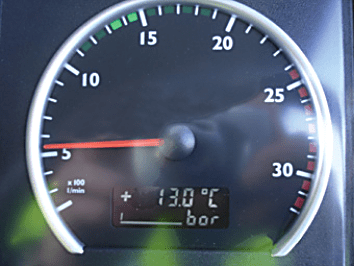
Explanation: The rev counter measures the speed of the engine, in revolutions per minute. Generally, the higher the revs, the more fuel the engine is using, so drivers should keep an eye on the rev counter to help drive in a more eco-friendly manner.
Question 4 of 10
What is the main reason for maintaining the correct tyre pressures?
Explanation: The vehicle manufacturer specifies the pressure to which tyres on a vehicle should be inflated. This is the pressure that gives the best performance in road holding, efficient braking and fuel consumption. Some manufacturers specify different pressures for front and rear tyres.
Question 5 of 10
What does Anti-lock braking system (ABS) do?
Explanation: Anti-lock braking system (ABS) is a type of braking system found in most modern cars. It comes into play automatically when the driver brakes harshly. In the wet it can help prevent the wheels from skidding so that, if necessary, the driver can continue to steer while braking. Be aware that ABS does not reduce the braking distance.
Question 6 of 10
How could towing an overloaded trailer affect a vehicle?
Explanation: You should not take an overloaded trailer onto a public road. An overloaded trailer impairs the stability, steering and braking of the towing vehicle.
Question 7 of 10
In what way do motor vehicles harm the environment?
Explanation: Carbon monoxide is a poisonous gas emitted by vehicle exhausts into the atmosphere. Driving economically and keeping a vehicle well maintained can reduce the level of carbon monoxide emissions.
Question 8 of 10
What is the effect of a worn exhaust?
Explanation: A worn exhaust system can have a number of effects, including increased noise from the engine and more environmentally damaging fumes (as they are not filtered properly). There are requirements to ensure vehicles are compliant with EU and Irish legislation. Vehicles are tested for compliance during road worthiness testing.
Question 9 of 10
What can be affected by driving on under-inflated tyres?
Explanation: Under-inflated tyres may adversely affect many of the vehicle's systems, including its braking ability, suspension, steering and fuel consumption. In particular, under-inflated tyres can affect the vehicles braking ability and can result in premature tyre wear. Tyres should always be inflated according to the vehicle manufacturers guidelines, information on which can be found in the vehicle handbook.
Question 10 of 10
What should a driver do to minimise fuel consumption in their vehicle?
Explanation: Driving smoothly will help reduce fuel consumption. Read the road ahead and adjust speed in good time, and avoid harsh acceleration and late braking.
Practise all 100 Technical Matters questions
803 questions with English and Portuguese audio. 40 free questions a day.