Syllabus category
Managing Risk
The second biggest block. It tests how you read hazards and keep space around the car.
Share of the test
9 / 40
23% of the questions
In our bank
207
questions in this category
To pass
35 / 40
in 45 minutes
What it covers
- Following distance and stopping distance
- Bad weather, night and glare
- Vulnerable road users
- Fatigue, distraction and alcohol
- What to do after a collision
Category quotas used in the TheoryPass mock test.
10 sample questions
Tap an answer to check it. Each question has English and Portuguese audio.
Score: 0/10
Question 1 of 10
What should a driver do to avoid having to make an emergency stop?
Explanation: When driving in traffic, read the road ahead and keep a safe distance from the vehicle in front. Use the two-second rule to determine your safe distance from the vehicle in front.
Question 2 of 10
What phrase is recommended for drivers to help them determine a safe distance from the vehicle in front on a dry road?
Explanation: A driver can judge a safe distance from the vehicle in front by using the two second rule. This is measured by picking a fixed point. As the vehicle in front passes it, begin saying "only a fool breaks the two second rule". If you pass the fixed point before you have finished the phrase, then your vehicle is too close, safely slow and increase your distance from the vehicle in front.
Question 3 of 10
When dazzled by the lights of an oncoming vehicle, what should a driver do?
Explanation: If dazzled by the lights of an oncoming vehicle, do not look directly at the oncoming lights. Instead glance towards the verge until the vehicle has passed and/or slow down and stop if necessary. This will avoid any temporary blindness caused by the brightness of the oncoming lights.
Question 4 of 10
The driver is following these two vehicles and wishes to overtake - what must the driver consider before overtaking here?
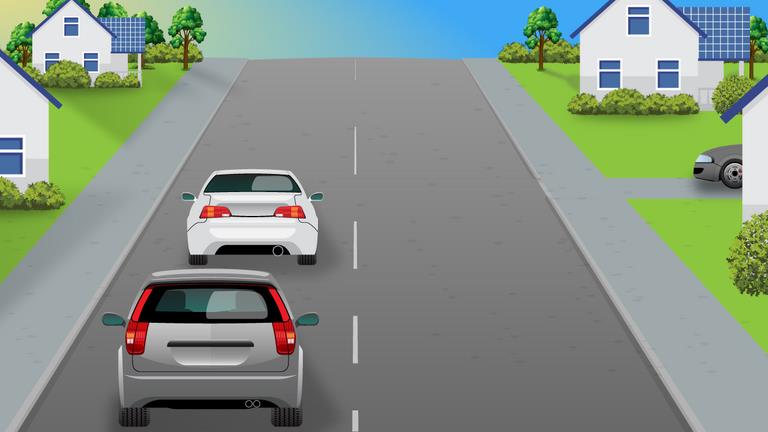
Explanation: You should always make sure that the road ahead is clear so that there is enough distance to allow you to overtake and get back to the correct side of the road without forcing any other road user to alter speed or course. In this case, the brow of the hill is too close to allow a driver to overtake safely.
Question 5 of 10
If a vehicle breaks down on a motorway, what should a person do?
Explanation: When a vehicle breaks down on a motorway, a driver should move the vehicle to the hard shoulder, use the roadside phone to contact the Gardaí, and do not place a warning device on the motorway. The driver should never try to do repairs themselves in the hard shoulder.
Question 6 of 10
What should a driver do if their vehicle breaks down on an automatic railway level crossing?
Explanation: In this situation, you and all passengers should get out of the vehicle and immediately use the emergency phone at the crossing to contact the signal operator so that trains can be stopped. If necessary, warn other motorists. Do not return to the vehicle until instructed by the signal operator or emergency services.
Question 7 of 10
When driving on a country road without footpaths, what should a driver expect coming towards them on their side of the road?
Explanation: Where there is no footpath, pedestrians are required to walk on the side of the on-coming traffic and drivers should be aware of this. Pedestrians are vulnerable road users so drivers should always be aware of their presence, especially on country roads.
Question 8 of 10
In dry weather how might a driver judge what is a safe following distance to vehicle in front?
Explanation: A driver can judge a safe distance from the vehicle in front by using the two second rule. This is measured by picking a fixed point. As the vehicle in front passes it, begin saying "only a fool breaks the two second rule". If you pass the fixed point before you have finished the phrase, then your vehicle is too close, safely slow and increase your distance from the vehicle in front.
Question 9 of 10
What should a driver do when driving at night on an unlit road?
Explanation: While driving at night and even with the best headlights, it can be very difficult to see all the hazards that you might come across : for example, pedestrians wearing dark clothing. As always drivers should drive at a speed that will enable them to stop safely within the distance they can see to be clear ahead.
Question 10 of 10
What should a driver do when driving at night on an unlit road?
Explanation: While driving at night and even with the best headlights, it can be very difficult to see all the hazards that you might come across, for example, unlit e-scooters on the road. At night you should drive at a speed that will enable you to stop safely within the distance you can see to be clear ahead.
Practise all 207 Managing Risk questions
803 questions with English and Portuguese audio. 40 free questions a day.